A Comprehensive Guide to Humidification and Dehumidification
Why Knowing When Humidification or Dehumidification Makes Sense Can Transform Your Home Comfort
Understanding when humidification or dehumidification makes sense is one of the most overlooked parts of keeping your Indianapolis home comfortable, healthy, and protected year-round. Most homeowners only notice humidity when something already feels wrong — the air is stifling in July, or skin is cracking and floors are creaking every January.
Here is a quick reference to help you decide what your home needs right now:
| Situation | What You Need |
|---|---|
| Indoor humidity below 30% RH | Humidifier |
| Indoor humidity above 50% RH | Dehumidifier |
| Dry skin, static shocks, or cracking wood | Humidifier |
| Musty odors, window condensation, or mold spots | Dehumidifier |
| Winter heating season in Indianapolis | Usually humidification |
| Summer months with high outdoor humidity | Usually dehumidification |
| Humidity between 30%–50% RH | No action needed |
The sweet spot for indoor relative humidity is 30% to 50%. Below that range, dry air irritates your respiratory system and damages wood surfaces. Above it, excess moisture encourages mold, dust mites, and structural damage. Central Indiana's climate swings hard in both directions across the seasons, which means the right answer in February is often the opposite of the right answer in August.
This guide walks you through exactly how to read the signs, measure what is actually happening in your home, and choose the right solution.
When humidification or dehumidification makes sense terms to remember:
- how humidity control extends equipment life
- how whole home humidity control saves energy
- is a whole home humidity system worth it
Understanding the Science of Indoor Humidity
To make smart decisions about your home's air, it helps to understand the basic science of indoor humidity. We often talk about "relative humidity" (RH), which is the amount of water vapor actually present in the air compared to the maximum amount of water vapor the air can hold at that specific temperature.
Because warm air expands, it can hold significantly more water vapor than cold air. When cold outdoor air sneaks into your home during an Indianapolis winter and gets heated up by your furnace, its relative humidity plummets. This is why indoor winter air can easily drop to 20% or 25% RH—which is actually drier than the Sahara Desert!
Conversely, in the summer, warm and moisture-laden outdoor air enters our homes. Even if your air conditioner cools this air down, the cooling process alone might not remove enough moisture to keep you comfortable.
According to the famous Sterling Chart—a staple of building science—maintaining indoor humidity between 30% and 50% (or up to 60% according to some extended comfort standards) creates a "Goldilocks zone." In this optimal range, the survival rates of airborne viruses and bacteria are at their lowest, dust mite populations collapse, and respiratory passages remain hydrated and healthy.
When relative humidity wanders outside of this safe zone, your health, your home, and your pocketbook suffer. Taking control of this balance is a core part of our modern Indoor Air Quality Solutions.

What is a Humidifier and How Does It Work?
A humidifier is a device designed to add moisture to your indoor air when things get uncomfortably dry. In residential settings, there are three primary types of humidification technology:
- Evaporative Humidifiers: These systems use a fan to blow air through a wet wick or pad. As the air passes through, water evaporates naturally into the stream. They are highly self-regulating because as the air's humidity rises, it naturally evaporates less water.
- Ultrasonic Humidifiers: These units use a metal diaphragm vibrating at an ultrasonic frequency to create micro-fine water droplets, which are propelled into the room as a cool mist. While quiet and efficient, portable ultrasonic units can spread mineral "white dust" if you do not use distilled water.
- Steam Humidifiers: These systems heat water to a boil, creating pure steam that is directly injected into your home's airflow. Steam systems offer incredibly precise control and are highly hygienic because the boiling process kills any pathogens in the water supply.
By adding moisture back into dry air, humidifiers prevent the air from acting like a sponge that sucks moisture out of your skin, sinuses, and wooden furniture.
What is a Dehumidifier and How Does It Work?
A dehumidifier does the exact opposite of a humidifier: it extracts excess moisture from air that is too damp.
Most residential dehumidifiers are compressor-based (refrigerant) systems. They work very similarly to an air conditioner. The unit draws in warm, humid air and passes it over a set of freezing-cold evaporator coils. As the air cools down, it reaches its dew point, causing the water vapor to condense into liquid droplets on the coils (just like condensation forming on a cold glass of sweet tea on a July afternoon). This water drips into a collection bucket or out through a drain line.
One interesting piece of physics to keep in mind is latent heat. When water vapor condenses back into liquid water, it releases heat. A compressor dehumidifier then blows the air across warm condenser coils before returning it to the room. Because of this, dehumidifiers actually warm the air slightly as they dry it, delivering an effective sensible heating COP (Coefficient of Performance) of about 2.1 under typical indoor conditions.
For cooler spaces like crawlspaces or basements, desiccant dehumidifiers are sometimes used. Instead of cooling coils, they use a chemical drying agent (like silica gel) to absorb moisture directly from the air, making them highly effective in temperatures where refrigerant coils would simply freeze over. Installing one of these systems is one of the most reliable Dehumidifiers to Enhance Air Quality in damp below-grade spaces.
When Humidification or Dehumidification Makes Sense
Knowing exactly when humidification or dehumidification makes sense comes down to measuring your air rather than guessing. We always recommend that homeowners purchase a few inexpensive digital hygrometers and place them at breathing height in frequently used rooms, away from direct sunlight, drafty windows, or heat registers.
Because Central Indiana experiences dramatic seasonal swings, you will likely need to adjust your approach throughout the year. In general, your target should look like this:
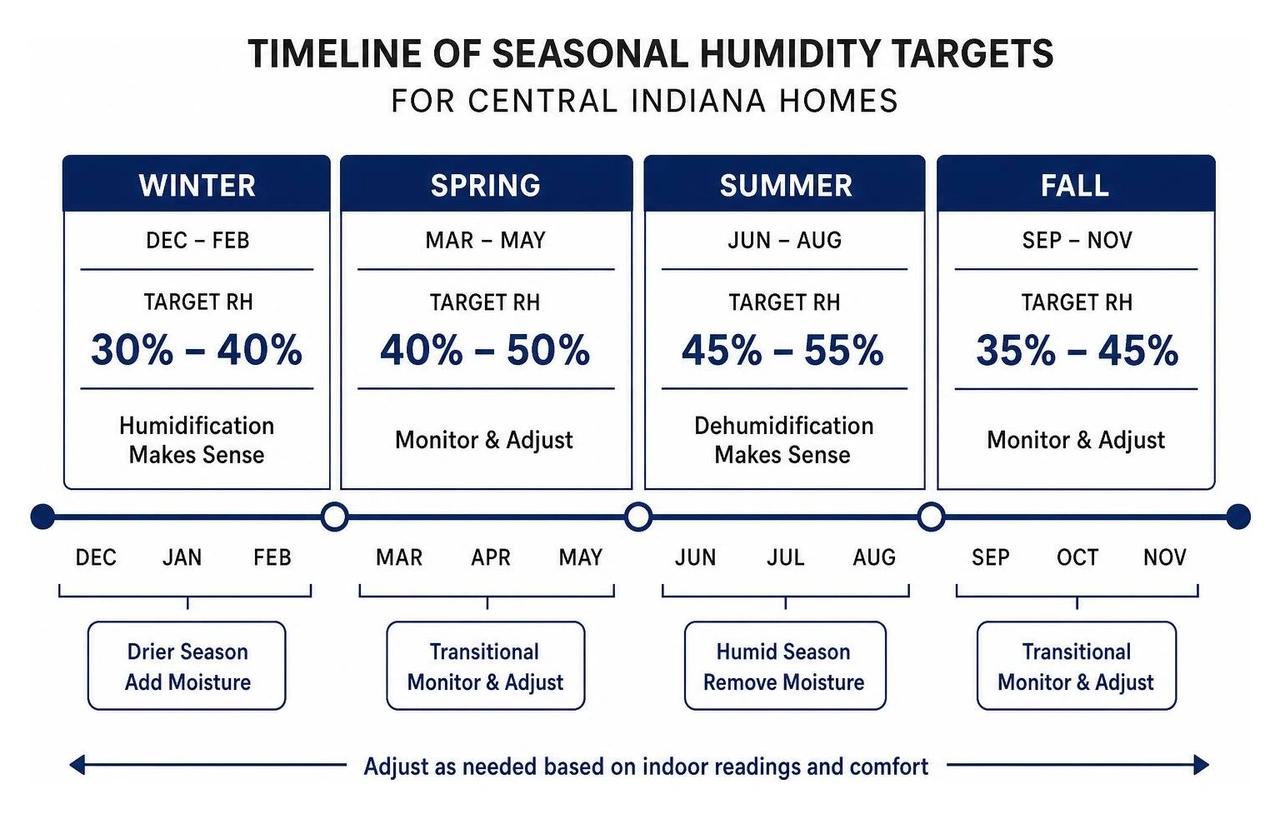
To help you quickly diagnose what your home is trying to tell you, look at this breakdown of symptoms:
| System Status | Low Humidity Symptoms (Need Humidifier) | High Humidity Symptoms (Need Dehumidifier) |
|---|---|---|
| Physical Sensations | Dry, itchy skin; chapped lips; static shocks when touching doorknobs; scratchy throat; dry nasal passages or nosebleeds. | Sticky, clammy, or heavy air; difficulty sleeping; feeling unusually hot at normal thermostat settings. |
| Home & Structure | Gaps opening up between hardwood floorboards; squeaky stairs; peeling wallpaper at seams; musical instruments going out of tune quickly. | Condensation forming on window panes; musty, earthy odors; mold or mildew spots on walls or ceilings; sticking doors and drawers. |
| HVAC & Performance | The air feels colder than the actual thermostat setting, tempting you to crank up the furnace. | The air conditioner runs constantly but the house still feels muggy and uncomfortable. |
Recognizing when humidification or dehumidification makes sense in winter
During an Indianapolis winter, humidification is almost always the priority. When the outdoor temperature drops below freezing, the absolute amount of moisture in the outdoor air is incredibly low. When that air makes its way inside through natural ventilation or air leaks, and your furnace heats it up to 70°F, the indoor relative humidity can easily drop below 20%.
This extreme dryness is more than just an annoyance. It dries out your respiratory system's mucous membranes—which are your body's first line of defense against winter colds and flu. It also causes wood to shrink, which can permanently damage expensive hardwood floors, trim, and cabinetry.
Adding a system from our range of Whole Home Humidifiers Indianapolis IN introduces controlled moisture directly into your ductwork, keeping your home's RH in the comfortable 30% to 40% range even during the coldest winter cold snaps.
However, there is a limit. You must adjust your winter humidity target based on how cold it is outside. If you try to maintain a 50% RH inside when it is 10°F outside, you will create a high dew point (~60°F) inside your walls. This risks moisture condensing on cold window glass or, worse, accumulating inside your wall sheathing where it can cause hidden rot and mold.
In winter, keep your targets modest:
- Outdoor temp above 40°F: Target 40% RH
- Outdoor temp between 20°F and 40°F: Target 35% RH
- Outdoor temp below 20°F: Target 30% RH
Recognizing when humidification or dehumidification makes sense in summer
When summer hits Carmel, Fishers, or Noblesville, the script flips completely. Hot, humid air dominates the outdoors, and indoor activities like showering, cooking, and doing laundry add even more moisture to your indoor air.
While your air conditioner naturally removes some moisture as it cools your home, it is designed primarily to control temperature, not humidity. During mild, humid spring or autumn days—or during humid summer nights when the AC isn't cycling often—indoor humidity can easily climb above 55% or 60%.
This is when you must Control Indoor Humidity Dehumidifier technology. Keeping your summer relative humidity strictly below 50% (and definitely below 60%) is crucial to prevent mold spores from germinating and to stop dust mites from multiplying.
Additionally, dry air feels cooler than damp air because it allows your body's natural sweat to evaporate efficiently. By keeping the humidity low, you can set your thermostat a few degrees higher in the summer while feeling just as comfortable, saving you money on your monthly energy bills.
Whole-Home Systems vs. Portable Units
If you have decided that your home needs humidity adjustment, the next big question is whether to use portable, single-room units or invest in a whole-home system.

While portable units are inexpensive upfront, they come with significant drawbacks. They only treat the air in one specific room, they require you to manually fill water tanks or empty heavy condensate buckets daily, and they can be incredibly noisy. Portable humidifiers are also notorious for growing mold inside their water basins if they aren't scrubbed clean every couple of days.
Whole-home systems, on the other hand, are installed directly into your existing HVAC ductwork. They treat all the air circulating through your home, providing consistent comfort in every room.
But do they really live up to the promise? To learn more, read our detailed breakdown: Do Whole Home Dehumidifiers Really Work.
The Benefits of Whole-Home Humidifiers
For central Indiana homeowners, a whole-home humidifier is a game-changer during the long winter months.
- Set It and Forget It: These systems connect directly to your home’s water supply line. There are no heavy tanks to carry or refill.
- Even Distribution: Because the moisture is injected directly into your furnace's supply plenum, it is distributed evenly to every room in your house via your ductwork, preventing dry zones.
- Energy Savings: Moist air holds heat better than dry air. When your home has proper humidity, the air feels warmer, allowing you to lower your thermostat setting without sacrificing comfort. Discover how this works in our guide on How Whole Home Humidity Control Saves Energy.
- Hygienic Operation: Whole-home bypass or steam humidifiers drain away excess water rather than letting it sit in a stagnant pool, drastically reducing the risk of mold or bacterial growth.
The Benefits of Whole-Home Dehumidifiers
If your home suffers from summer mugginess, damp basements, or musty crawlspaces, a whole-home dehumidifier is the ultimate solution.
- Continuous Drainage: Unlike portable units that shut off the moment their small buckets fill up, whole-home dehumidifiers are piped directly into a floor drain, sump pump, or condensate pump. They run continuously until your target humidity is met.
- Whisper-Quiet Comfort: Because the actual compressor unit is installed in your basement, utility closet, or attic, you won't have to listen to a loud appliance humming in your living room or bedroom.
- Protecting Your Ductwork: By drying the air before it circulates through your cooling system, a whole-home dehumidifier prevents moisture from pooling inside your dark ductwork, keeping mold from taking hold.
- Reduced AC Wear and Tear: Your air conditioner doesn't have to work nearly as hard when the air is already dry, extending the life of your cooling system. Get a complete look at these systems in our Whole Home Dehumidifiers Guide.
Maintaining Your Humidity Control Systems
Like any mechanical equipment, both whole-home humidifiers and dehumidifiers require regular maintenance to operate efficiently and safely.
For humidifiers, the main task is replacing the evaporator pad (also called a water panel) once or twice per heating season. Over time, mineral deposits from your tap water build up on this pad, restricting airflow and reducing the system's ability to evaporate water. If you have a steam humidifier, the steam canister will need to be checked and occasionally replaced to prevent scale buildup.
For dehumidifiers, regular maintenance includes cleaning or replacing the air filter to keep airflow high, and checking the condensate drain line to ensure it isn't clogged with dust or algae.
To keep your systems running flawlessly, check out our best practices for Maintaining Whole Home Dehumidifiers. Taking care of these systems is a smart investment, and you can learn more about how proper How Humidity Control Extends Equipment Life keeps your entire heating and cooling setup running smoothly for years to come.
Frequently Asked Questions About Home Humidity Control
Managing indoor air quality can raise a lot of questions. Here are some of the most common things we hear from homeowners in Indianapolis, Carmel, Fishers, and surrounding areas.
Can you use both a humidifier and a dehumidifier in the same home?
Yes, absolutely! In fact, in a climate like Central Indiana's, using both is often the only way to achieve true year-round comfort.
However, you do not run them at the same time. You will use your whole-home humidifier during the cold, dry winter months to add needed moisture. In the hot, sticky summer months, you will turn off the humidifier and run your dehumidifier to pull excess moisture out of the air.
Modern smart thermostats and dedicated humidistats make this incredibly easy. They can monitor your indoor air and automatically switch between humidification and dehumidification modes based on the season, ensuring your home stays perfectly balanced without you having to lift a finger.
What is the ideal indoor relative humidity range?
The Environmental Protection Agency (EPA) and leading building scientists recommend keeping your indoor relative humidity between 30% and 50%.
Staying within this range keeps your home comfortable, protects your belongings, and prevents health issues. If your humidity drops below 30%, you risk dry skin, respiratory irritation, and wood shrinkage. If it climbs above 50%, you create an environment where mold, mildew, and dust mites thrive.
Does an ERV or HRV replace a dehumidifier?
No, an Energy Recovery Ventilator (ERV) or Heat Recovery Ventilator (HRV) is not a replacement for a dedicated dehumidifier.
While ERVs and HRVs are excellent for bringing fresh outdoor air into tightly sealed, modern homes, they are designed for ventilation, not active moisture removal. An ERV does transfer some moisture between the incoming and outgoing air streams to reduce the humidity load coming into your home, but it cannot actively pull moisture out of your indoor air to lower the overall relative humidity. If your home is running damp, you will still need a dedicated dehumidifier to keep things comfortable.
Conclusion
Finding the right balance and knowing when humidification or dehumidification makes sense is essential for creating a healthy, comfortable, and efficient home in Central Indiana. Whether you are dealing with static shocks and dry skin in the winter or musty odors and sticky air in the summer, you don't have to live with uncomfortable indoor air.
At LCS Heating and Cooling, we are proud to serve homeowners across Indianapolis, Carmel, Fishers, Lawrence, Noblesville, and Zionsville. Our trained technicians specialize in custom indoor air quality solutions designed specifically for your home's unique layout and needs.
With our signature 7-Star Concierge Service, we emphasize promptness, clear communication, and total respect for your home. We make sure you are fully informed every step of the way, providing lasting comfort solutions that keep your family healthy and happy.
If you are ready to take control of your home's air quality, explore our Indoor Air Quality Services or contact us today to schedule a professional consultation. Let us help you find your home's perfect comfort zone!
Recent Posts
Does Running Your AC Fan on 'ON' Instead of 'AUTO' Help Clear Stale Air?

How Excessive Attic Heat in August Degrades Your Flexible Ductwork